
Over 200 experiences to support emotional wellbeing and reduce pain or anxiety during procedures
Nature, animals, cities, museums, performing arts, music, relaxation and Street View to accompany procedures, treatments and hospital stays.
A proposal designed for real-world use.
Nature and animals
Calm experiences with landscapes, wildlife and natural environments.
Towns and cities
Immersive trips to well-known places around the world.
Museums and culture
Art, heritage and incidental learning.
Music and performing arts
Concerts, ballet and cultural experiences.
Relaxation
Conscious breathing, mindfulness and guided exercises.
Street View
Personalized exploration of meaningful places.
Virtual reality changes brain activity
Several neuroimaging studies have shown that virtual reality modulates brain activity in areas involved in pain perception, attention and emotion, promoting greater wellbeing during the experience.
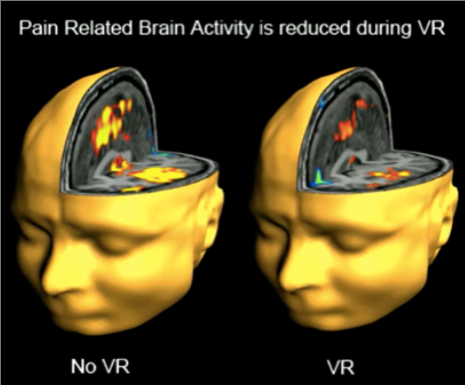
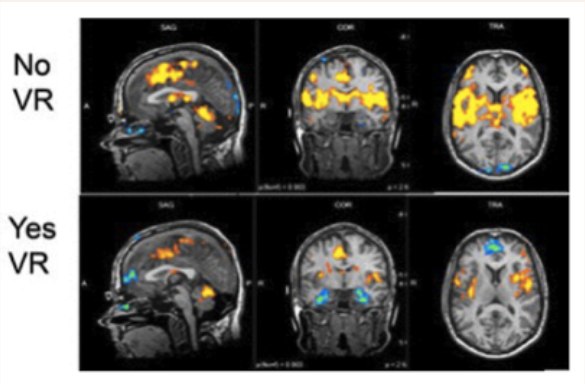
Reduction of pain-related brain activity.
FMRI scans showing pain-related brain activity (in yellow) with and without virtual reality.
University of Washington.
Lower activation of pain-processing areas.
Three-dimensional representation of brain activity during a painful stimulus, with and without virtual reality.
University of Washington
How does it work?
Captures attention
Immersive environments redirect the patient's attention, reducing focus on the painful stimulus.
Modulates brain activity
Decreases activation in areas related to pain perception (insula, anterior cingulate and somatosensory cortex).
Reduces anxiety
Promotes a state of relaxation and emotional control.
Increases wellbeing
Generates positive emotions that improve the care experience.
Clinical results that support its use
The reduction in pain-related brain activity during virtual reality has been observed in multiple neuroimaging studies and clinical trials across different care settings.
Integration into the care workflow.
Before and after procedures
Preparation, distraction and emotional recovery.
Oncology and dialysis
Support during long sessions.
ICU and hospitalization
Wellbeing, stimulation and connection with the outside world.
Palliative care
Calm, comfort and meaningful experiences.
What it brings to patients and professionals.
Where it is used
Integration into the care workflow.
✓ Before and after procedures Preparation, distraction and emotional recovery.
✓ Oncology and dialysis Support during scheduled sessions.
✓ ICU and hospitalization Wellbeing, stimulation and connection with the outside world.
✓ Palliative care Calm, comfort and meaningful experiences.
Emotional wellbeing
Promotes positive emotions and a more humane care experience.
Stress reduction
Offers relaxation environments and conscious breathing.
Reminiscence and communication
The content can trigger memories and conversation.
Intervention sheets
Objectives and questions adapted to different profiles.
Results and criteria for use.
Clinical results backed by studies and scientific evidence.
Immersive experiences
Catalog organized by themes and objectives.
Emotional support available
Content usable at different moments of the care process.
Adapted sheets
Interventions adjusted to different levels of cognitive impairment.
Practical information.
Nature, animals, travel, museums, music, performing arts, relaxation and Street View.
Yes. The professional can choose content based on preferences, life history and objective.
Yes. Oroi TV and on-screen viewing allow the experience to be discussed with other people.
Duration is adapted to the patient, the procedure and professional judgment.
Consider its application in your center.
We prepare a demo adapted to your unit, procedure and population.